


Industrial Caster
What is Industrial Caster
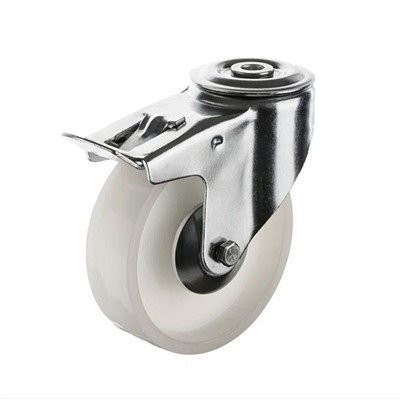
Industrial caster wheel is one of the most important assemblies of all trolleys manual material handling systems. It assures stable, silent, vibration-free movement on all kinds of surfaces under load. This wheel is made of tough steel alloy with corrosion resistant surface coating and assures long service life.
Benefits of Industrial Caster
Reduced risk to the workplace
Ergonomic industrial caster are designed to minimize the risk of workplace injuries. They improve maneuverability, stability, and control, and reduce the likelihood of slipping and falling. With features like smooth rolling, shock absorption, and precise steering, ergonomic casters help prevent accidents and injuries from unstable or difficult-to-maneuver equipment.
Increased mobility due to the presence of bearings in ergonomic casters
one of the important components of ergonomic industrial caster is the bearing that improves the mobility of the casters, and casters with bearings require less force due to the presence of bearings to move objects.
Preventing injury to workers
Ergonomic industrial caster can help reduce the incidence of musculoskeletal disorders (MSDs) among workers. By creating smooth and easy movement, ergonomic casters minimize the stress on the body of employees when pushing or pulling heavy loads. They reduce the risk of physical stress associated with manual work.
Increased productivity and efficiency
Using ergonomic industrial caster can significantly improve productivity and efficiency in various workplace environments. With smoother rolling and improved maneuverability, workers can move materials or equipment faster and easier. This reduces downtime and delays, streamlines workflow, and allows workers to perform tasks more efficiently.
Protection of equipment and infrastructure
Ergonomic industrial caster not only benefit workers but also help protect equipment and infrastructure in the workplace. The shock-absorbing properties of the ergonomic casters minimize vibration and shock during transport, reducing the risk of damage to fragile equipment or sensitive materials. Additionally, ergonomic casters with non-marking or ground-friendly casters help prevent scratching floors or surfaces.
Compatibility with different environments
Ergonomic industrial caster are available in different types and configurations to adapt to different environments and applications. Whether it's an industrial setting, healthcare facility, office, or retail space, there are ergonomic casters to meet specific needs. This compatibility ensures that workers can effectively use ergonomic casters in different work environments.




Why Choose us
Quality options
We stock a range of light-, medium-, and heavy-duty casters ideal for a wide range of applications.
Selection help
We can help you determine the right casters for your specific application and work site.
Competitive pricing
Our quality casters and wheels are available at competitive prices to help you control costs.
Professional Test
Walking performance test, salt spray test, brake fatigue test, load test, impact force test and etc.
Equipment That Uses Industrial Caster Wheels
Factory equipment
Certain types of factory equipment may need added mobility should regulations or operational workflow change. While you must keep some equipment bolted to the floor for safety, you can install caster sets on other pieces to lessen the workload required in a layout shift or reset.
Beds and furniture
Hotels, offices, and other workspaces use heavy furniture to keep guests and employees comfortable throughout their time there. However, some circumstances may require you to move these items to a different location. Industrial casters prioritize safety and stability in their designs. Simply apply the brakes when you want the furniture to remain stationary and release them when you need to move something.
Dollies and carts
Grocery stores, clothing stores, and home improvement warehouses have customers making daily large- and small-scale purchases. In other industrial facilities, employees also need quick access to vehicles that improve mobility and productivity. Heavy-duty carts and dollies fitted with industry-leading casters and wheels will meet these needs perfectly.
Spaces That Utilize Industrial Industrial Caster Wheels

01.Warehouses
02.Distribution centers
03.Retail stock rooms
04.Factories
05.Foodservice
06. Storage centers
Common Industrial Caster Materials and Application Types
Steel
One of the most common materials for forks, axles, plates and stems is steel. Steel is used because it is a very common metal with great strength and durability. Steel comes in many different varieties such as forged steel and plate steel so it can be used in different ways for whatever particular caster component is being made. Additionally, steel can have many different surface finishes applied that will offer protection from rust and corrosion such as zinc plated finish, nickel plated finish, chrome plated finish, and passivized steel. All offer good corrosion resistance and provide a superb looking finish.
Cast Iron
Another common material for the components of a industrial caster is cast iron. Iron can be cast into whatever shape is desired for the component in question, and is extremely durable and strong after casting. Cast iron can also be machined to very precise final dimensions if required and still retain its strength and durability. The one issue with cast iron is that it is difficult to make corrosion resistant for applications where this is a problem.
Plastic
With advances in plastic development, there are now industrial caster that use a very durable plastic, such as polyamide, for the outer caster materials such as forks. These materials, while not as strong as steel or iron, are completely rust free. For high humidity applications such as hospital carts that need to be put into a disinfecting cubicle, this is much more desirable than the corrosion resistance that is available for the steel coating mentioned above. When the coating is scratched or damaged, the material underneath can become exposed to humidity causing rust, a situation that is not a concern with the plastic materials.
Different Types of Industrial Casterwheels for Industrial Applications
Solid rubber wheels
Solid rubber wheels are known for their durability and ability to absorb shock. They are ideal for heavy-duty applications that require excellent load-bearing capacity and impact resistance. These wheels are often used in automotive manufacturing, aerospace industries, and warehouses where smooth and quiet operation is essential.
Polyurethane wheels
Polyurethane wheels offer a combination of strength, durability, and floor protection. They are resistant to chemicals, oils, and solvents, making them suitable for industries that deal with corrosive substances. Polyurethane wheels are commonly used in food processing plants, pharmaceutical industries, and manufacturing facilities where hygiene and cleanliness are crucial.


Nylon wheels
Nylon wheels are known for their high load-bearing capacity and resistance to wear and tear. They are lightweight, non-marking, and offer excellent maneuverability. Nylon wheels are commonly used in industries that require frequent movement and transportation of heavy loads, such as logistics and distribution centers.
Metal wheels
Metal wheels, usually made of cast iron or steel, are extremely durable and capable of handling heavy loads. They are resistant to extreme temperatures and can withstand rough terrains. Metal wheels are commonly used in industries such as construction, mining, and material handling where ruggedness and durability are paramount.
Factors to Consider When Choosing Industrial Casters
Load capacity
Determine the maximum weight the industrial caster wheels will need to support. Be sure to choose wheels with a load capacity that exceeds your requirements to ensure safety and longevity.
Floor type
Consider the type of surface the wheels will be used on. Smooth floors, rough terrains, or outdoor environments may require different wheel materials and designs.
Mobility requirements
Assess the need for maneuverability and ease of movement. Swivel casters allow for multidirectional movement, while rigid casters provide stability in straight-line motion.
Environmental conditions
Take into account the temperature, moisture, and chemical exposure in your industrial environment. Certain materials are better suited for extreme temperatures or corrosive substances.
Noise and vibration
If noise reduction is a priority, choose wheels with features such as shock absorption or cushioning to minimize vibrations and noise levels.
Maintenance and cleaning
Consider the ease of cleaning and maintenance required for the industrial caster wheels. Some materials may require regular lubrication or cleaning to ensure optimal performance.
Diameter
The larger the diameter, the easier it is to push or move your object, especially from a standstill. So before you place an order, make sure to measure the diameter of the caster you’re replacing. If that’s not an option, then keep in mind your application. A larger caster will be easier to move, but you don’t want to go so large that your load is too high or the center of gravity is off. To measure the diameter of your caster, lay it on its side and measure from edge to edge across the center of the wheel.
Width
In most cases, the width of industrial casters impacts its capacity, so the wider the caster, the more weight it can bear. If you are moving machinery or other heavy load, you will want to consider a wider caster. If you load is light, for example a work cart, you can likely select a more narrow caster. To measure the width of your caster, stand it up and measure from the edge of the wheel to the edge of the wheel (not crossing over the center of the entire caster).

How To Maintain Industrial Casters
Keep your industrial casters clean from dirt and corrosion
Depending on the area where your industrial casters operate, you might have to deal with dirt and moisture that will get trapped in the bearings and the raceways.
To inspect this you can check how freely the swivel assembly turns. When this isn’t the case, dirt or rust may be hindering the movement. Use a scrub brush to try to remove the dirt and corrosion as much as possible without having to disassemble the castor wheel.
Lubrication of the industrial caster and its bearings is one of the most important aspects. This prevents the bearing from wearing down. Reapplying lubrication is necessary roughly every six months, but factors such as the amount of usage, humidity and chemicals used in the area of operation can impact how often you need to check the lubrication. After washing or submerging the castors in water, reapplication of the lubrication might be necessary.
Use High-Quality all-purpose grease for lubrication. Make sure to use a food-safe option when lubricating castors that are being used in kitchens or other areas where food is prepared. You will also need to make sure that the lubrication you are using can handle high temperatures when the castors are used in places such as ovens, furnaces and other warm areas.
When using the industrial caster wheels, vibrations can loosen the fasteners slightly over time. Regularly control the fasteners and welds of the castors to see if there are broken parts or id it needs to be tightened. If the caster has a king bolt nut, make sure it is securely fastened as well.
During your routine checkup of the industrial caster and its parts, make sure that none of them has cracks or other malfunctions. When using plastic or rubber wheels, also check the state of the material, as it may develop flat spots.
The importance of industrial caster grease
Industrial caster grease is specifically formulated to withstand the unique demands placed on caster wheels. It reduces friction, protects against wear and tear, and can even prevent rust and corrosion. Without it, the constant rotation and weight-bearing can quickly wear down even the most robust wheels.
Selecting the right industrial caster grease
With various options available, selecting the right industrial caster grease can be daunting. Consider factors like viscosity, temperature range, and load capacity. For industrial casters bearing heavy loads or operating in high-temperature environments, a high-viscosity, heat-resistant grease is essential. For everyday office or furniture casters, a standard lithium-based grease may suffice.
Application of industrial caster grease
Proper application is just as important as the type of grease you choose. Apply a thin, even layer to the wheel’s bearing, ensuring it penetrates to reduce friction effectively. It’s essential not to over-lubricate, as excess grease can attract dirt and debris, leading to a counterproductive outcome.
Maintenance and reapplication
Regular maintenance schedules should include checking the consistency and level of industrial caster grease. Over time, grease can become contaminated or dry out, necessitating reapplication to maintain optimal wheel performance.
Keep Your Industrial Casters Rolling: Four Pitfalls To Avoid
Excessive Speed
Using your industrial casters at speeds beyond what they are rated for can be a mistake. As speed increases, so do the impact loads imparted on the caster when traveling over expansion joints or other obstructions. Theses increased impact forces can cause brinelling – defined as a permanent deformation — of the swivel section raceways or even damage the wheel or caster legs.
Excessive speed can also lead to premature failure of polyurethane tires due to the extra heat generated from a higher frequency of material deflection. It is very important to understand what speeds the industrial casters will be used at and to consult the factory to make sure the caster design will be appropriate for that application.
Uneven Loading
A major cause of heavy-duty caster failure is uneven loading of carts or tools equipped with casters. Whether caused by the objects on the cart or the inherent cart design, this imbalance will cause one industrial caster to carry a significantly larger proportion of the load. This could lead to premature wear of the heavy-duty caster or even complete caster failure with a magnified impact load. When specifying industrial casters for your application, it is best to try to understand the load distribution on the casters.
Rough Terrain
Using industrial casters on rough terrain can also lead to caster failure. Rough terrain can impart large impact loads on the caster, which can cause brinelling in the swivel section. Rough terrain can also cause polyurethane and other soft tires to chunk out and fail prematurely. When taking casters over rough terrain, it is best to design some sort of shock absorbing capability into the caster.
Excessive Temperatures
Using industrial casters at elevated temperatures (above 100°F) can also be a cause of caster failure. When operating temperatures begin to exceed 100°F, wheel material selection becomes important as softer materials will tend to flat spot or even melt. As temperature continues to increase, grease selection becomes an important factor to application success. If the wrong type of grease is used, it could become liquefied, run away from the areas it is supposed to lubricate and greatly increase the chances of bearing or swivel section failure. When elevated temperatures are a part of your application, it is best to consult with the factory to properly specify an industrial caster for your application.
How to Clean and Lubricate Industrial Caster Wheels
Gather materials
You'll need two soft clothes, a suitable lubricant like WD-40, a small brush (or toothpick), and rubber gloves.
01
Clean
Use a clean, soft cloth to wipe off any dirt on the industrial caster's surface.
02
Lubricate
Spray lubricant onto every moving part of the industrial caster.
03
Brush
Use a toothbrush or toothpick to reach the nooks and crannies.
04
Wipe
Wipe away any excess lubricant with a separate clean, soft cloth.
0
Our factory
As a professional manufacturer, UNIONLEVER makes various specifications of the range of industrial castors, casting products, elector-plating products, industrial small handcart, sheet metal stamping, injection molding, PU founding and other products. We have 1 set of automatic foundry production line, 2 of advanced PU wheel casting production line, 5 of semi automatic vehicle processing equipment imported from Japan, 8 of semi automatic lathe in the vehicle processing workshop, 4 set of full automatic advanced molding machine in the injection molding workshop, 25 set of equipment from 50 tons to 400 tons of weight 10 of automatic welding machine in the stamping workshop. In 2014, we invested to construct in the elector-plating workshop, at present operation is normal with daily processing capacity of 20,000.
We sticks to "people-oriented" management principle, with "quality, honesty, responsibility, gratitude" as the leading quintessence for enterprise culture. The company constantly introduces high-tech, high-level managerial staffs and technical personnel together of a number of mechanical processing, material engineering, industrial automation, marketing and other areas of the professional sources to engage in R & D work jointly to become customers qualified supplier for a number of products. We will provide customers with the most enthusiasm, perfect after sale service.

Asked Questions
As one of the leading industrial caster manufacturers and suppliers in China, we warmly welcome you to wholesale cheap industrial caster from our factory. All customized products are with high quality and competitive price. Contact us for free sample.
industrial caster, 2 inch steel casters, industrial style wheels for furniture